
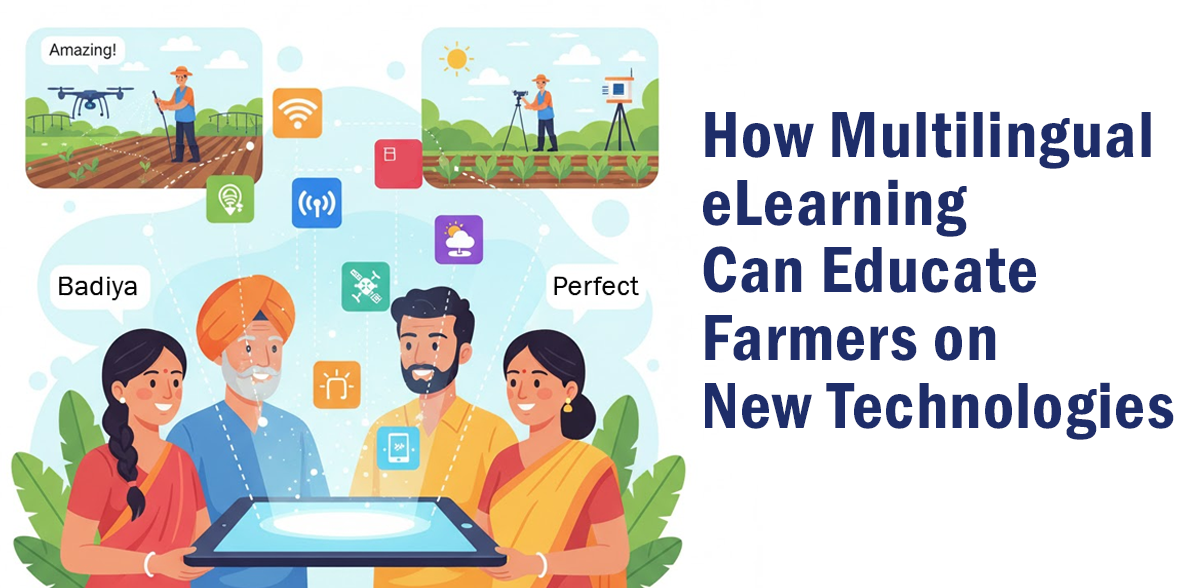
Agriculture today has shifted beyond the traditional ways. Today, technology has started playing a very important role. It helps in increasing production, sustainability, and profitability. The farmers in today’s tech world use smart irrigation systems, drones, AI-based crop monitoring and other weather forecasting tools.
However, here comes the main challenge – to make the farmers understand, trust and own these new developments, especially rural areas. Well! Worry not. Here’s the solution – localized eLearning. Using native languages to spread information or educate farmers about products/services make it easier for the brands to gain trust and become a local’s favorite. Moreover, localized eLearning helps in bridging the cultural and communication gap while wide-spreading use of technology in agriculture.
Research shows that learning in one’s native language improves retention and adoption by up to 70%.
The Effectiveness of Multilingual eLearning in Rural Education
In India, the majority of the population, nearly 600 million people depend on agriculture for their survival, which includes various languages and dialects from various regions. And, a one-size-fits-all approach does not work here. It requires a personalized strategy, which incorporates farmers’ native language, culture and context.
And, that is where multilingual eLearning becomes the game-changer for brands targeting diverse audiences. Following are some of the factors that shows how effective multilingual eLearning is in rural education:
1. Makes understanding easier
No matter which language, multilingual eLearning localizes the modules, videos or even audio and product descriptions into the diverse native languages. Using these, farmers could easily understand various subjects like soil testing, machinery operation or crop rotation without worrying about literacy or formal education.
2. Scalable, cost-effective and impactful
eLearning content can be easily spread through various mediums and across several locations at a very minimum expense. Moreover, with the use of mobile phones increasing in rural parts of India, such videos or modules create a huge impact on people.
3. Makes learning meaningful
Undoubtedly, interacting with the courses or modules which are personalised and is presented in one’s native language, taking examples from their surroundings. This cultural adaptation makes learning more personal and meaningful.
Strategies for Effectively Delivering Multilingual eLearning to Farmers
To use the multilingual eLearning to empower farmers and help them in adoption of the trendy technologies, it first must be created, localized and delivered in an accurate way. Following are the significant strategies to effectively deliver the multilingual eLearning programs to farmers.
1. Using Voice and Video-Based Microlearning
Farmers who are used to text-heavy information benefit from short, visual content in their own language. Animated movies, field demonstrations, and local farmer success stories can help to make complicated technology more understandable and entertaining.
2. Collaboration between Local Experts and Agri-Influencers
Collaboration with regional agricultural colleges, Krishi Vigyan Kendras (KVKs), and local agri-influencers ensures that the information delivered is correct, relevant, and relatable. Farmers tend to believe voices that sound like them and understand their problems.
3. Integration with mobile platforms and chatbots
Since most farmers now use smartphones, including localized eLearning programs into mobile-friendly platforms like WhatsApp chatbots can enable convenient access at any time and from any location. Voice-enabled chatbots in different languages can also provide real-time responses.
4. Localization Beyond Translation
Simply translating English training content into Hindi or Marathi is not sufficient. To effectively localize, pictures, examples, tone, and even humor must be tailored to area cultures and agricultural practices. This humanizes the learning process.
5. Data-driven feedback and improvement
Collecting feedback from farmers after each lesson, in their native language, can assist to improve future learning content. Insights like understanding levels, favored themes, and engagement patterns might help make programs more effective over time.
Conclusion
Multilingual eLearning is not only about making agricultural education available in various languages but also about making it relevant. Moreover, it helps in bridging the gap between the rural farmers and new trends and innovations, enabling them to adopt it easily and be active players in the agri-tech revolution.
Furthermore, this helps in making farmers well-informed about drone mapping, precision irrigation, and AI-based yield prediction, without any language barrier. Multilingual eLearning not only makes understanding easier but also builds trust.
So, are you ready to ensure that your agricultural technology information reaches and educates farmers? If yes, let us help you localize and reach your audiences easily.